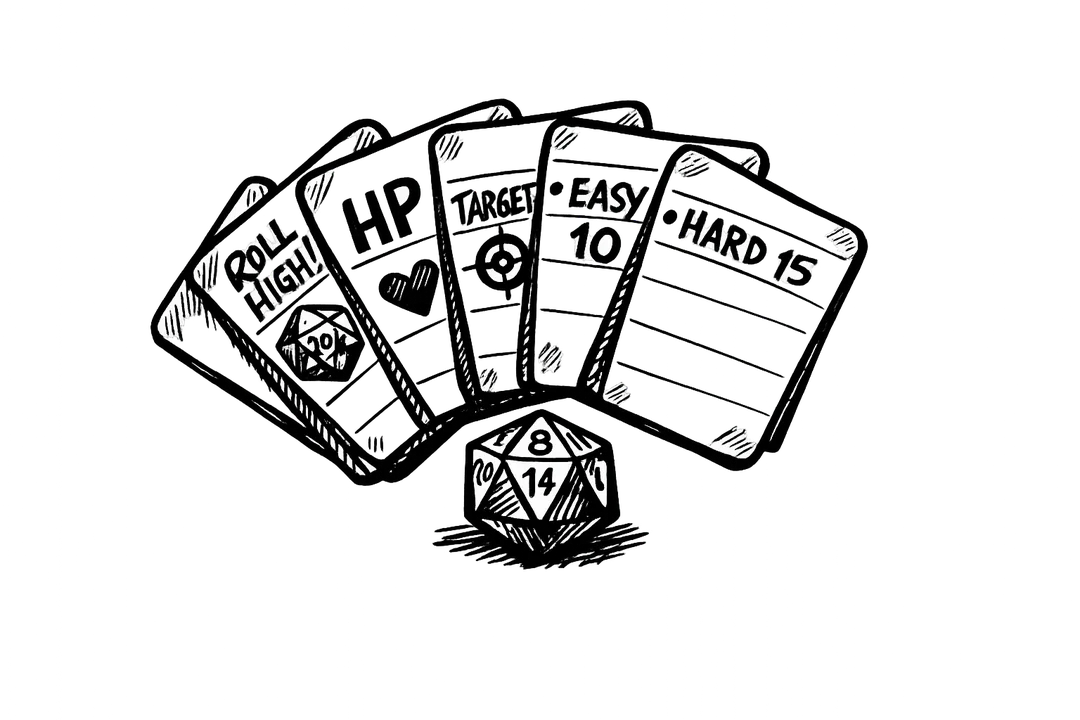
🎯 The Core Mechanic
- Roll d20 + Stat Bonus
- Meet or beat the Target Number to succeed
- The GM sets ONE Target for the whole room
- Target Often around 10–14
- EASY Target −3 for that roll
- HARD Target +3 for that roll
- Nat 20 Critical success — a big effect
- Nat 1 Fumble — something goes wrong
- Defense 10 + armor bonus; monsters roll d20 + bonus vs it
💪 Stats
| Stat | Used For |
|---|---|
| STR | Melee attacks, lifting, breaking |
| DEX | Ranged attacks, stealth, acrobatics |
| CON | Endurance, resist poison/disease |
| INT | Knowledge, investigation, devices |
| WIS | Perception, willpower, tracking |
| CHA | Persuasion, intimidation, leadership |
Stats are bonuses (+1, +2, etc.), not scores.
⚔️ Effort (Damage & Progress)
| Type | Die | When |
|---|---|---|
| Basic | d4 | Bare hands, simple tasks |
| Weapons / Tools | d6 | Swords, lockpicks, hammers |
| Guns | d8 | Firearms |
| Energy / Magic | d10 | Spells, powers, psionics |
| Ultimate | d12 | Rare, powerful sources |
Roll Effort (+ bonuses) after a successful attempt: it deals damage or makes progress on an obstacle’s HP or timer.
♥️ Hearts & HP
- 1 Heart = 10 HP
- Players start with 1 Heart (10 HP)
- Monsters are described in Hearts (more Hearts = tougher)
- Damage reduces HP; more Hearts mean more HP
- Dying: at 0 HP you face a short countdown of rolls each turn — get help before it runs out
📏 Distance Zones
| Zone | Range | Movement |
|---|---|---|
| CLOSE | Melee range | Free to move within |
| NEAR | Throwing range | 1 move action |
| FAR | Bow / spell range | 2 move actions |
No grids or squares — zones radiate from each character.
🔄 Turn Order
- Turns go around the table
- No initiative rolls — just go around the table
- On your turn: 1 Action + 1 Move
- Action Attack, cast, use item, attempt
- Move Move about NEAR distance
- Enemies act on the GM’s turn
⏱️ Timers
- GM sets a countdown die (often d4 or d6) or a number of rounds
- It ticks down each round
- When it runs out, something happens
- Reinforcements, traps trigger, door locks, ritual completes
- Timers create urgency — use them often!
🎒 Loot = Progression
- No levels — loot IS your power growth
- Items grant stat bonuses, effort bonuses, abilities
- Equipped and carried slots (often 10 each)
- Loot can be found, crafted, bought, or earned
- Milestones (and Master Edition’s Mastery for repeated success) also advance characters
👹 Monster Toughness (this guide’s rule of thumb)
| Tier | Hearts | Behavior |
|---|---|---|
| Minion | ½ (5 HP) | Drop in one or two hits, come in groups |
| Standard | 1–2 | Typical foes, balanced threat |
| Elite | 3–4 | Tougher, special abilities |
| Boss | 5+ | Major threat, multiple actions, phases |
📇 GM Quick Tips
- One Target per room — don't overthink difficulty per action
- Timer on the table — if there's no urgency, add one
- Say YES — if it's cool, let them try. Set the Target and roll.
- Index card = encounter — fit the whole room on one card
- Loot solves problems — reward creativity with items, not XP
- D.E.W. (this guide’s framework) — every room needs Danger, Energy and Wonder